Venus of Lespugue
Always happy and excited to engage with everything (prehistoric) Goddess-related! Especially the ancient artifacts that I have incorporated into my Media Priestess artworks, as they have deeply inspired me and illuminated my soul.
This time I encountered a contemporary version of the Venus of Lespugue: a giant balloon-like goddess sculpture made of stainless steel by Jeff Koons and exhibited at the Museum of Cycladic Art in Athens. I enjoyed her monumental presence and the juxtaposition of scale and material. She appears soft, light, and almost inflatable, as if filled with air, while simultaneously remaining grounded, steady, and imposing, formed from a dense and heavy metallic substance. She feels both powerful and delicate, playfully inviting the viewer to come closer and explore the multiple reflections of oneself across her mirrored curved surfaces.
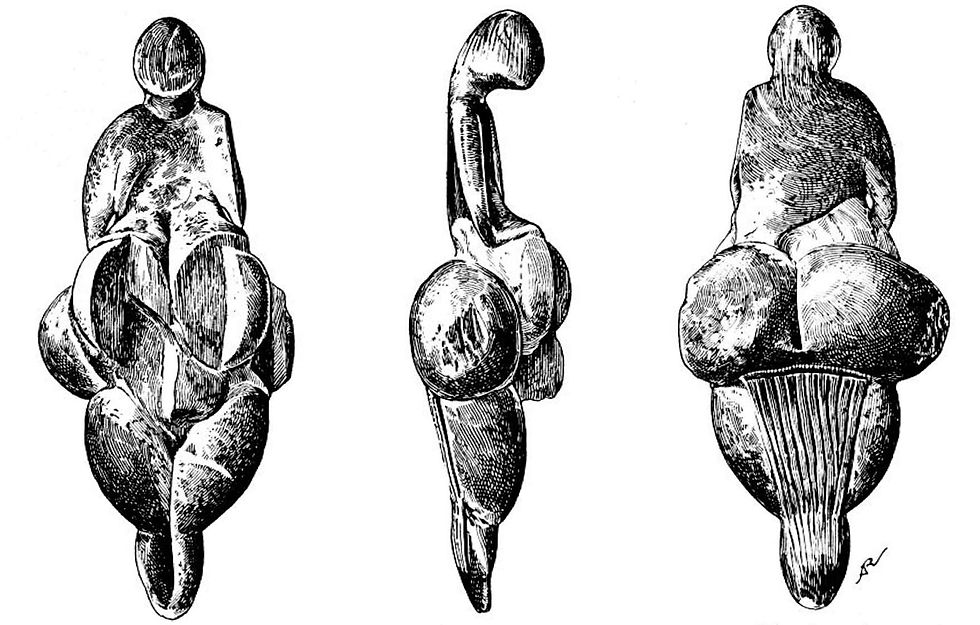
The original Venus of Lespugue was created between 26,000 and 24,000 years ago in the foothills of the Pyrenees. Standing only about 15 cm tall, she was carved from mammoth ivory and was damaged during excavation. The figurine emphasizes the life-giving and life-sustaining aspects of the female body through rounded forms that evoke fullness, abundance, and fertility. Her large breasts, belly, and buttocks resemble eggs and seeds—symbols of potential life—while also bringing to mind much later Goddess forms such as Artemis of Ephesus. The original figure also bears carved lines beneath the buttocks resembling a fringe skirt, a motif found in several prehistoric female figurines across Europe.
In Koons' contemporary interpretation, the fringe skirt beneath the buttocks is absent, while on the front there is a circular opening that the artist refers to as a 'mound.' While often understood as a formal sculptural element connected to his balloon aesthetic, its placement also evokes the yoni, a womb opening or a liminal passage between worlds.
In my own media priestess artwork from 2020, created as a birthday gift to myself, the Venus of Lespugue is positioned beneath clusters of grapes whose rounded forms echo her voluptuous silhouette. Ripe, nutrient rich and full of sweetness the grapes evoke abundance, fertility, and vitality. They are soft and filled with spores and juice, carrying the potential for new life and transformation, while bringing to mind states of ecstasis and altered perception, radical embodiment and divine intoxication.
Alongside her appear two other ancient female figurines. One, particularly close to my heart, comes from Nea Nikomedeia (6250-6050 bce), a Neolithic settlement located near my father's birthplace in Central Macedonia, Greece. The other is the seated female figurine with serpent-like eyes from Sesklo (5800-5300 bce), associated with one of Europe's oldest Neolithic cultures—a site I recently visited and hope to share more about in the future.

I love prehistory—the time before "his-story"—because it is a realm where what once existed remains open to interpretation through intuition, imagination, and reason. For thousands of years these figurines rested within Gaia's womb, hidden in caves and beneath layers of earth. They emerged again to show us the possibility that different ways of being once existed and can exist again, revealing the values that are rooted deeply within us through memories that can survive even when buried.
Comments